
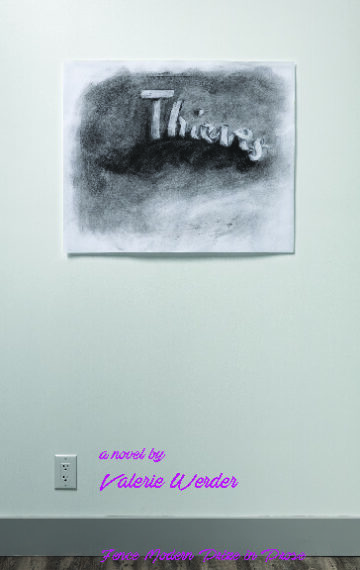
- Publisher: Fence Books
- Available in: Paperback, Ebook, Audiobook
- ISBN: 1944380213
- Published: August 8, 2023
Selected for The Fence Modern Prize in Prose by Rebecca Wolff
“Sly, witty, and utterly compelling, Valerie Werder’s Thieves illuminates how we create and examine our selves in thrall to late capitalism—and how we’re all thieves of one kind or another. This novel gives immense pleasure...”
—Claire Messud
Valerie Werder’s debut novel, Thieves, is an autofictional account of the strivings and struggles of an art worker also named Valerie. On the cusp of adulthood, Valerie finds herself working at a gallery in the big city, generating empty sales copy and living surrounding by a storm of hollow, shimmering commodities. Thieves follows Valerie as she becomes increasingly aware of the ways she can acquire and be acquired, eviscerating in whip-smart and sharply humorous prose the industries of desire and consumption which produce, place value on, and limit her creativity, freedoms, and responsibilities.
Valerie Werder is a writer, researcher, dancer, and educator. She is currently a doctoral candidate at Harvard University, where she is at work on a dissertation about police bodycam footage. Her work has been published in Public Culture, Film Quarterly, BOMB, and Flash Art and exhibited at Participant Inc, New York; A.I.R. Gallery, Brooklyn; and Artspace, New Haven. She lives in Somerville, Massachusetts with a black cat, dozens of plants, and hundreds of books.
Thieves is available also as an audiobook wherever audiobooks are sold.
Read an interview about the novel with Valerie Werder and Jason Zuzga.
JZ: What made you decide to write the novel?
VW: About two years into working at the gallery, I met the person who roughly corresponds with Ted. He had all of the wonderful and contagious optimism of a con man, and he convinced me that I should take this new skill of producing a continuous stream of language away from my boss and use it for my own purposes. Seize the means of language production, which was myself! . . . I wanted to set up conditions under which I could produce language in a voice that would be called “my own,” but totally unselfconsciously. I was interested in writing a book because I’d done so much short-form, fragmentary writing at the gallery, and wanted to see how these consumable, fragmentary texts could be layered and accumulated into something more dense and unwieldy.

